

How Many PRSI Contributions Do You Need for the State Pension in Ireland?
To qualify for the State Pension (Contributory) in Ireland, you generally need at least 520 full-rate PRSI contributions. This is equivalent to around 10 years of contributions.
However, reaching 520 contributions does not automatically mean you will receive the full State Pension. The amount you qualify for depends on your overall contribution history.
This guide explains what the numbers mean, how to check your record and what to consider if the State Pension may not provide enough income for the retirement you want.
How Many PRSI Contributions Do You Need?
The main figures to understand are:
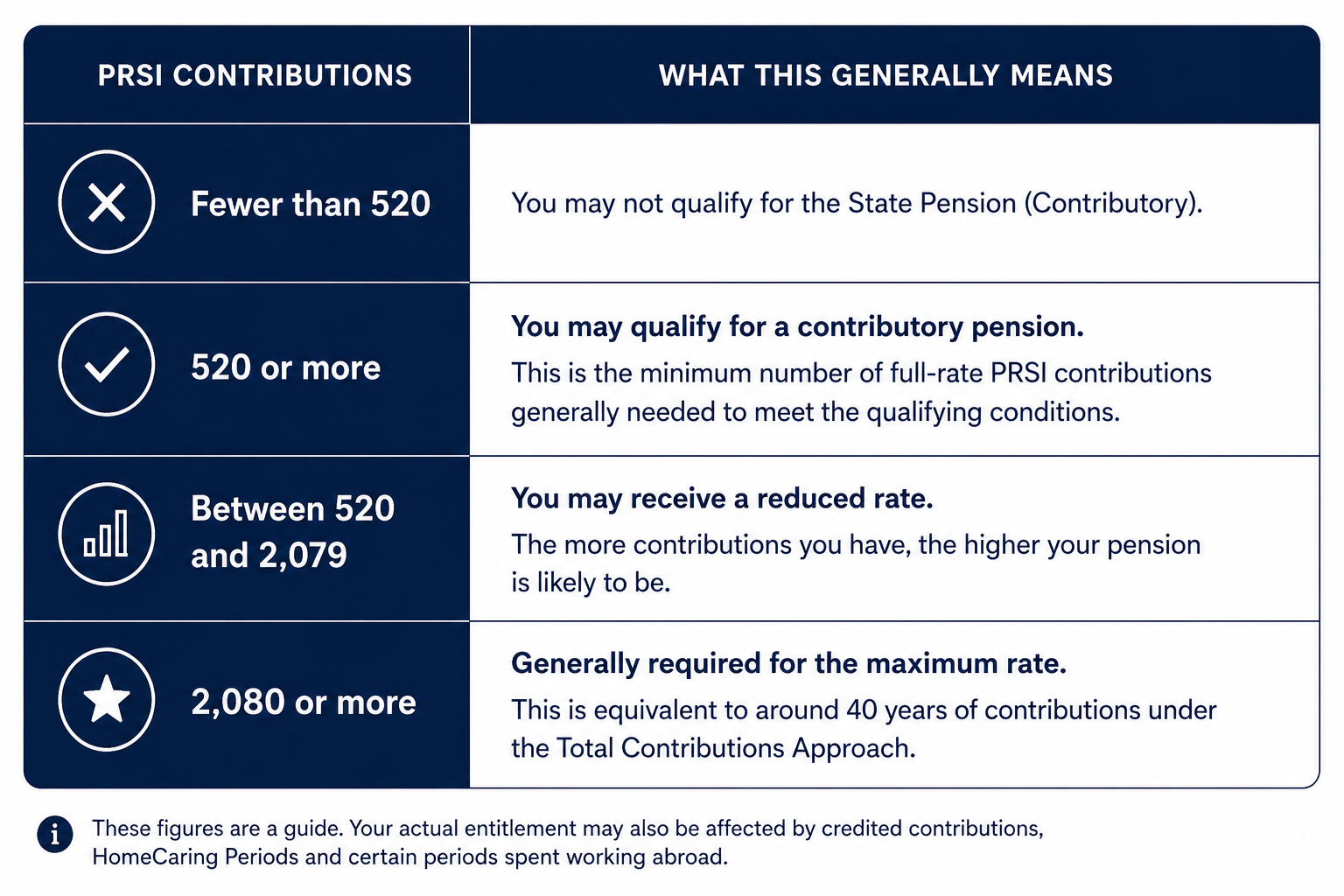
The 520 contributions needed to qualify must generally include full-rate paid contributions. Your complete record may also include credited contributions, home caring periods and other reckonable contributions.
Does 520 Contributions Give You the Full State Pension?
No.
Having 520 contributions means you may meet the minimum contribution requirement. It does not guarantee the maximum payment. Under the Total Contributions Approach, the Department of Social Protection looks at the number of reckonable contributions you have built up over your working life. You generally need 2,080 contributions, equivalent to approximately 40 years, to receive the maximum rate under this calculation. A person with fewer contributions may receive a reduced rate.
Your actual entitlement will depend on your individual record, so the figures should be treated as a guide rather than a personal pension calculation.
How Is the State Pension Calculated?
Ireland is gradually moving towards a system known as the Total Contributions Approach. In simple terms, this looks at the total number of reckonable contributions on your record rather than relying mainly on the average number of contributions paid each year.
The older Yearly Average method is being phased out between 2025 and 2034. During the transition, the Department of Social Protection may calculate a pension using more than one method and award the more favourable result where applicable.
You do not need to calculate this yourself before checking your record. The practical first step is to request your Contribution Statement.
How Can You Check Your PRSI Contributions?
You can request a Contribution Statement through MyWelfare using a verified MyGovID account.
The statement shows the social insurance contributions recorded under your name. It can help you identify:
How many contributions you have built up
Whether there are gaps in your record
The classes of PRSI contributions recorded
Whether you may need further guidance before retirement
The Department of Social Protection recommends MyWelfare as the quickest way to request your contribution history. It is worth doing this well before you plan to retire. Finding a missing contribution or unexplained gap is much easier when you still have time to investigate it.
What If There Are Gaps in Your PRSI Record?
A gap does not necessarily mean that the period will be completely ignored. Depending on your circumstances, your record may include:
Credited contributions
Home caring periods
Contributions made while self-employed
Social insurance contributions from certain other countries
Voluntary contributions
Credited contributions
You may receive credited contributions during certain periods when you are unable to work, such as periods of unemployment or illness, provided you meet the relevant conditions.
Credits may help protect your social insurance record, but limits can apply when they are used to calculate the State Pension.
Time spent caring for someone
Home Caring Periods may be available for time spent caring for a child under 12 or a person who required an increased level of care.
Under the Total Contributions Approach, up to 1,040 Home Caring Periods may be included in a person’s record. This is equivalent to 20 years, although eligibility rules apply.
Working abroad
If you worked in another EU or EEA country, the UK or a country that has a social security agreement with Ireland, contributions from both countries may be considered when deciding whether you qualify.
This does not necessarily mean that Ireland will pay your entire pension. Each country may pay a portion based on the insurance record built up there.
Because international records can be more complicated, it is sensible to check your position early.
Voluntary contributions
Some people who stop paying compulsory PRSI may be able to protect their future entitlement by paying voluntary contributions.
There are eligibility conditions and time limits, so this is something to investigate when you leave employment or become exempt from compulsory PRSI rather than waiting until retirement.
What Happens If You Do Not Have 520 Contributions?
You may not qualify for the State Pension (Contributory) if you do not meet the required contribution conditions.
However, this does not necessarily mean that you will receive no State support.
You may be able to apply for the State Pension (Non-Contributory). This is a means-tested payment, so your income, savings, investments and other financial circumstances may be assessed.
The contributory and non-contributory pensions are different payments with different qualifying conditions. It is important not to assume that you will automatically receive either one without checking your entitlement.

Can You Continue Working After 66?
Yes.
People can choose to claim the State Pension (Contributory) between the ages of 66 and 70.
Delaying your claim may allow you to continue building contributions, meet the minimum requirement or qualify for a higher payment. A later claim may also receive an actuarially increased rate, depending on the age at which the pension is drawn down.
Deferring will not be the right choice for everyone. Your health, employment income, contribution record, tax position and wider retirement plans should all be considered.
Will the State Pension Be Enough?
That depends on what your retirement will cost.
The State Pension can provide an important foundation, but it may not replace the income you earned while working.
Consider what you may need to pay for in retirement:
Housing and household bills
Food and everyday expenses
Transport
Healthcare and insurance
Holidays and hobbies
Home maintenance
Financial support for family
Unexpected costs
Your housing position can make a particularly large difference. Someone who owns their home without a mortgage may need a very different income from someone who expects to rent or continue making loan repayments.
Rather than choosing a pension target based on a general rule, start by estimating what your own retirement is likely to cost.
Do You Need a Private Pension?
A private pension is not legally required for everyone, but many people use one to supplement the State Pension.
You may already have pension benefits through:
A workplace pension scheme
A Personal Retirement Savings Account
A personal pension
Additional Voluntary Contributions
Pensions from previous employers
The important question is not simply whether you have a pension. It is whether your State Pension, private pensions, savings and other income are likely to support the life you want after work.
Private pension contributions may qualify for Income Tax relief within Revenue’s age-related and earnings limits. Relief is not unlimited, and the amount available depends on your age, earnings and existing pension contributions.
Tax relief can make pension saving more attractive, but it should not be the only consideration. Charges, investment risk, access restrictions and retirement options also matter.
How Much Pension Do You Need?
There is no single figure that applies to everyone.
A useful starting point is to work through four questions:
1. What will your essential expenses be?
Estimate the cost of housing, bills, food, transport, insurance and healthcare.
2. What kind of retirement do you want?
Think about travel, hobbies, social activities and other spending that matters to you.
3. What income are you already likely to receive?
Include your estimated State Pension, workplace pensions, personal pensions, savings, investments and any other expected income.
4. Is there a gap?
Compare your likely retirement income with your estimated spending.
This gives you a more useful starting point than aiming for an arbitrary pension fund figure. Once you understand the potential gap, you can consider whether you need to increase contributions, review existing pensions or change your planned retirement date.
Practical Steps You Can Take Now
You do not need to wait until retirement is close to review your position.
Start by:
Requesting your PRSI Contribution Statement
Finding details of pensions from current and previous employers
Checking how much you and your employer currently contribute
Reviewing the charges and investment choices attached to your pensions
Estimating your likely spending in retirement
Comparing your expected income with the lifestyle you want
The earlier you identify a potential shortfall, the more options you are likely to have.
Frequently Asked Questions
Can I qualify for the State Pension with 10 years of PRSI?
You may qualify if you have at least 520 qualifying full-rate contributions and meet the other conditions. This does not necessarily mean you will receive the maximum rate.
How many contributions are needed for the full State Pension?
Under the Total Contributions Approach, you generally need 2,080 reckonable contributions for the maximum rate.
Can I receive the State Pension and a private pension?
Yes. Receiving an occupational pension, PRSA or personal pension does not normally prevent you from receiving the State Pension (Contributory), provided you meet its qualifying conditions.
Is the State Pension (Contributory) means-tested?
No. The State Pension (Contributory) is based primarily on your PRSI record rather than your income or savings.
The State Pension (Non-Contributory) is means-tested.
Can I check my PRSI record online?
Yes. You can request your Contribution Statement through MyWelfare using a verified MyGovID account.
Get a Clearer Picture of Your Retirement
Knowing how many PRSI contributions you have is an important first step, but it does not tell you whether your overall retirement plan is on track.
Your State Pension entitlement, existing pension funds, savings, retirement age and expected spending all need to be considered together.
Provest can review your current position, explain your options clearly and help you build a retirement plan based on the income and lifestyle you want.
Contact Provest to arrange a consultation and get a clearer understanding of your retirement options.